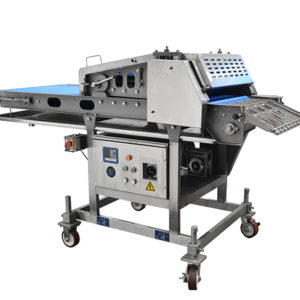
Meat Flattening Machine

December 18, 2025Admin
Meat Flattening MachineMeat Flattening Machine

Main Benefits
  • Ideal for preparing poultry, pork, beef, and fish steaks, cutlets, and fillets.
  • Processes all boneless meat under 50mm thickness.
  • Customized belt width and conveyor speed options.
  • Efficient 8-roller flattening increases meat surface area.
  • Uniform thickness reduces frying time for consistent cooking.
  • Hand wheel adjustment replaces wrench-based standard model.
  • Precise thickness control with clear manual graduations.
  • High-strength stainless steel rollers ensure durable performance.
  • Diamond-pattern belt prevents slippage for consistent quality.
  • Safety guard triggers automatic stop when opened.
  • Emergency stop button ensures immediate shutdown.
  • IP56 waterproof rating for robust protection.
  • Quick-release design simplifies daily cleaning.
  • Hydraulic flip-top allows easy access for maintenance.
  • Removable water tray maintains strict hygiene standards.
  • Integrated spray system prevents meat from sticking.
  • Adjustable control panel enhances operator comfort.
  • Lockable casters provide easy movement and stability.
  • OEM services and production line integration available.
Contact Our Specialists

Overview

The VERFOODSOLUTIONS upgraded meat flattening machine is engineered for food processors seeking unparalleled efficiency and practicality. Suitable for flatten all fresh meat pieces less than 50mm thick, including poultry meat, pork, beef, and fish, it features a revolutionary hand wheel thickness adjustment mechanism that replaces the traditional method requiring removal of a sprocket cover and wrench adjustments. Operators can effortlessly set precise thicknesses by turning a hand wheel, eliminating disassembly and tools, which significantly enhances productivity and ease of use. The machine’s stable lifting platform ensures accurate thickness control, while manually calibrated rollers with clear graduations allow for quick adjustments within a range of 0-50 mm. Customization options include belt widths of 300, 400, or 600 mm, input/output heights adjustable at 1030±50 mm, and mesh belt speeds from 3-15 m/min (or 4-19 m/min upon request).

Built for robust performance and safety, this meat flattening machine features high-strength 8-pass stainless steel pressure rollers and a specially designed diamond-shaped conveyor belt that provides excellent grip to prevent meat slippage. An anti-stick water spray system ensures smooth, continuous operation by preventing meat from adhering to surfaces. It meets a high IP65 waterproof rating and is equipped with customized features such as an automatic stop guard when opened, an emergency stop button, and a user-friendly control panel. A key upgrade includes a top-mounted control panel mounted on a fully adjustable rocker arm, allowing operators to easily position the panel for optimal comfort and visibility from any angle. Designed with convenience in mind, the machine also features a quick-release design, a hydraulic flip-top for easy access, a removable water collection tray, and a fully adjustable rocker arm for the control panel, all finished with a durable sandblasted surface for easy cleaning and long-lasting durability.

Videos

Features

  • Efficient 8-roller calendering uniformly flattens meat to reduce frying time and ensure consistent cooking results.
  • Wide applicability for processing boneless meat under 50mm thick, ideal for various cuts from poultry, pork, beef, and fish.
  • High customizability includes OEM options, adjustable belt width (300/400/600 mm), and input/output height (1030±50 mm).
  • Convenient handwheel thickness adjustment allows tool-free, quick calibration, replacing the wrench-based method of older models.
  • Rocker-arm intelligent control panel is fully adjustable for optimal operator positioning and comfort from any working angle.
  • Variable frequency speed conveyor with adjustable belt speed (3-15 m/min, customizable to 4-19 m/min) for precise process control.
  • High-strength 8-stainless steel pressure rollers provide robust flattening performance for high output and long-term durability.
  • Diamond-patterned anti-slip conveyor belt provides excellent grip to prevent meat slippage and ensure consistent product quality.
  • Integrated anti-stick spray system automatically mists during operation to prevent meat from adhering to the conveyor belt.
  • Comprehensive safety includes a guard with automatic stop and an emergency shutdown button for immediate machine stoppage.
  • Hydraulic side-mounted flip cover opens smoothly for easy cleaning, maintenance, and conveyor belt replacement.
  • Easy-to-remove water tank collects wastewater to maintain hygiene and simplify the end-of-day cleaning process.
  • Movable casters with locking mechanisms allow for easy workshop movement and stable operation in position.
  • High IP56 waterproof rating ensures reliable operation in humid food processing environments.
  • Seamless integration enables connection with tenderizing or coating equipment for continuous production lines.

Specifications

ParameterMF400-IIMF600-II
Belt Width(mm)400600
Input/Output Height (mm)1030±501030±50
Mesh Belt Speed (m/min)4-194-19
Adjustment Flattening Thickness (mm)0-500-50
Power (Kw)1.51.5
Dimensions (mm)2180×570×14002180×770×1400
Plate Material304 Stainless Steel304 Stainless Steel
Plate Thickness (mm)33
Rectangular Tube (mm)60×30×260×30×2
Waterproof RatingIP65IP65

FAQ

What is the application for the new design meat flattening machine and the upgraded flattener?

Both the new and upgraded flattener machines are specifically designed for processing a wide variety of boneless meat. Their core application is calendering fresh or frozen boneless meat pieces with a thickness of less than 50mm, provided the meat temperature is at or above 0°C during operation.

They are suitable for boneless cuts of:

  • Poultry (e.g., chicken breast, turkey cutlets)
  • Pork (e.g., pork chops, loin)
  • Beef (e.g., steaks, sirloin)
  • Fish (e.g., fillets)
  • Other boneless meat products

The machines use high-pressure rollers to uniformly flatten the boneless meat to a set thickness. This process increases the product’s surface area, which allows for a shorter frying time while achieving the same thorough cooking effect. They are ideal for efficiently preparing portion-controlled items like steaks, cutlets, chops, and patties from boneless meat.

What are the key differences and similarities between the new design meat flattener machine and the upgraded flattener?

The primary differences are in the control system and user ergonomics. The upgraded flattener features a significant upgrade with a top-mounted, IP65-rated control panel that is mounted on a fully adjustable rocker arm. This allows operators to easily position the panel for optimal comfort and visibility from any working angle. The standard model does not have this advanced, repositionable control panel.

The key similarity and a major upgrade for both models is the new design meat flattener machine revolutionary handwheel thickness adjustment for the flattened meats. This feature replaces the outdated, cumbersome method found on older machines, which required operators to remove a sprocket cover and use a wrench to adjust the rollers. Both the new design meat flattener machine and the upgraded flattener now allow for quick, precise, and tool-free calibration of meat thickness simply by turning a handwheel, greatly improving operational efficiency and ease of use.

What are the key steps for safely commissioning and operating the new design meat flattener machine for the first time?

When receiving your new design flattener machine, follow these essential commissioning steps:

Safe Handling & Placement: Use a forklift to move the equipment to your workspace, ensuring it’s positioned at least 500mm from walls for maintenance access on a flat, solid surface. Adjust casters as needed and properly ground the equipment.

  • Initial Inspection: After unpacking, thoroughly check that all electrical and mechanical components are secure, the conveyor belt is properly tensioned, drive chain is taut, and protective covers are correctly installed.
  • Trial Run Procedure: Even though the machine was pre-commissioned, always perform a no-load test run after installation. Check for loose fasteners, and if any abnormal noises occur, immediately stop the machine for inspection before restarting.
  • Proper Operation: For optimal calendering results, feed thawed raw meat with thickness ≤ 50mm evenly and continuously without overlapping. Adjust the mechanism as needed to achieve desired thickness specifications.

Following these steps ensures safe operation and extends your machine’s service life.

How do I adjust the meat flattening thickness on the design flattener machine?

To adjust the product outlet thickness, first turn the hand crank while referring to the scale markings to set the desired outlet height according to your product requirements. When adjusting, remember that turning the handwheel clockwise increases the product height, while turning it counterclockwise decreases the height. Always refer to the scale to ensure precise thickness settings for your specific product needs.

How do I properly tension the conveyor belt and ensure correct rotation direction on the design flattener machine?

To properly set up your conveyor system, first loosen the push rod of the conveyor belt drive roller and adjust the nut on the push rod to achieve the appropriate belt tension. After connecting the power supply, observe the conveyor belt’s movement direction to ensure it correctly guides meat pieces into the calender. For the output mesh belt, adjust its tension by moving the tension rollers up and down as needed. Proper tensioning ensures smooth operation and prevents belt slippage or misalignment during processing.

What are the essential maintenance procedures should I follow for the new flattener machine?

Machine Cleaning:

  • Always disconnect power before cleaning
  • Wash the machine with warm water and detergent/disinfectant
  • Rinse thoroughly with clean water
  • Keep water away from electrical equipment and junction boxes

Maintenance:

  • Regularly monitor for abnormal noise or vibration during operation
  • Immediately investigate and fix any unusual sounds or movements

Lubrication:

  • Lubricate the sprockets and chain on the reducer monthly
  • Follow manufacturer specifications for motor bearing and reducer lubricant replacement
  • Proper cleaning and regular maintenance ensure optimal machine performance and longevity.

What are the common troubleshooting steps for the design flattener machine?

If the machine won’t start:

  • Check for voltage in the circuit
  • Confirm the power cord is properly plugged in
  • Verify the equipment power switch is on
  • Check that the power fuse is working and the fuse holder is intact
  • If all checks are normal but there’s still no voltage, the circuit may be damaged and requires professional inspection

If the motor runs but the conveyor belt doesn’t move:

  • The conveyor belt is too loose and needs adjustment
  • Adjust the tension rollers to solve this problem

Important Note:

The machine housing and reducer are pre-lubricated at the factory and typically do not require additional lubrication during normal operation.

INTERESTING? REACH US TO GET Meat Flattening Machine PRICE NOW!

    Leave a Reply

    Your email address will not be published.

    You may use these HTML tags and attributes: <a href="" title=""> <abbr title=""> <acronym title=""> <b> <blockquote cite=""> <cite> <code> <del datetime=""> <em> <i> <q cite=""> <s> <strike> <strong>

    Get A Quote Today!

      Copyright © 2025 VER Food Solutions all rights reservedSitemap

      Leave a message


        Translate »