Manual to 7200 Samosas &Spring Rolls/Hr: VERFOODSOLUTIONS Preduster Battering Breading Fryer Line Boosted the USA Restaurant Chain
December 31, 2025Admin
Share
For second-generation food business owners, balancing legacy reputation with scalable production is never easy—especially when manual labor bottlenecks stand in the way of expansion. This is exactly the challenge a 20-year-old samosa specialist in San Francisco faced, until our tailored samosa spring roll coating line stepped in to turn the tide. Let’s dive into how this samosa coating line transformed their production efficiency and paved the way for new restaurant openings!
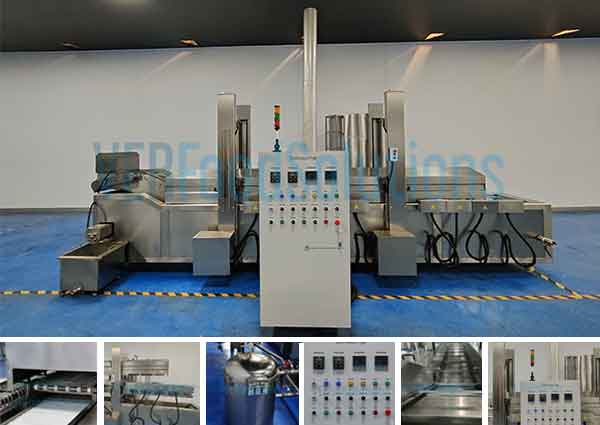
Recently, we shipped a preduster battering breading fryer line to one of our US customer, designed to seamlessly integrate with the client’s production process: samosas and spring rolls are formed by a samosa machine, which is elevated by a raised stainless steel platform. This elevation ensures the products are conveyed via a mesh belt at the same height as the subsequent coating line, creating a continuous workflow. The client’s production sequence follows: samosa making – predusting via preduster machine -dipping batter in tempura batter via tempura battering machine – breading via breading machine -continuous frying via continuous frying machine. Due to the client’s moderate output demand and limited workshop space, the current setup focuses on continuous frying; additional deoiling cooling machine will be added in the future when production scales up. Beyond samosas, the client also plans to add a mini nugget patty forming machine for chicken nugget and patties—a project still in the planning stage, with mold details to be discussed in the second half of 2026. From 200 per person per hour to 7,200 samosas/hour: a game-changer for a 20-year SF samosa business (5 restaurants, 3 more opening 2026). Manual limits (max 300/hour) and high labor costs (5 staff/restaurant for samosas/spring rolls) pushed them to buy our coating line in Dec 2025. Now it fuels expansion, solving food safety and freshness issues.
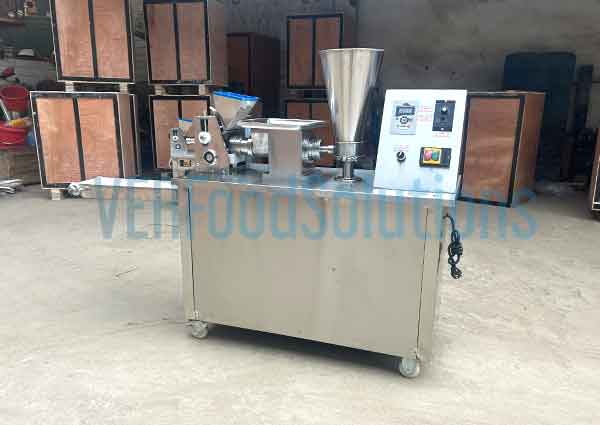
It’s worth noting that the production logic of our samosa spring roll machine is fundamentally different from traditional manual methods. Traditionally, the client’s hand-made samosas and spring rolls required wrapping fillings into individual wrappers repeatedly until the final products were formed. In contrast, our samosa machine innovatively produces both the filling and the wrappers (samosa wrappers and spring roll wrappers) simultaneously in one go. While hand-made products can have a crispy and rich texture, our machine-made products outperform them in raw material freshness. The key lies in the machine’s ultra-high efficiency: it can produce two finished products in just one second. This speed not only amplifies output but also minimizes manual contact with the food to the greatest extent, significantly reducing the risk of bacterial and microbial contamination—a critical advantage for meeting strict food safety standards in the US market.
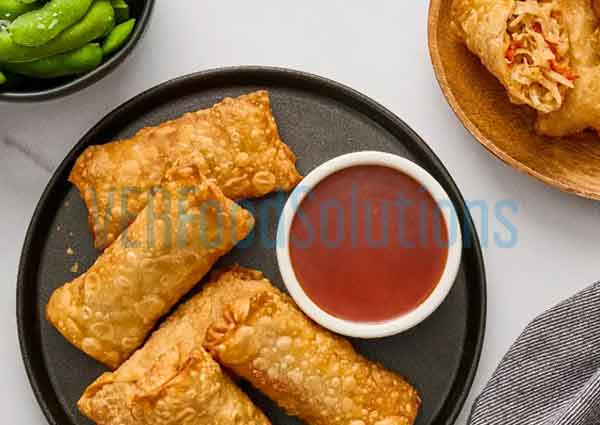
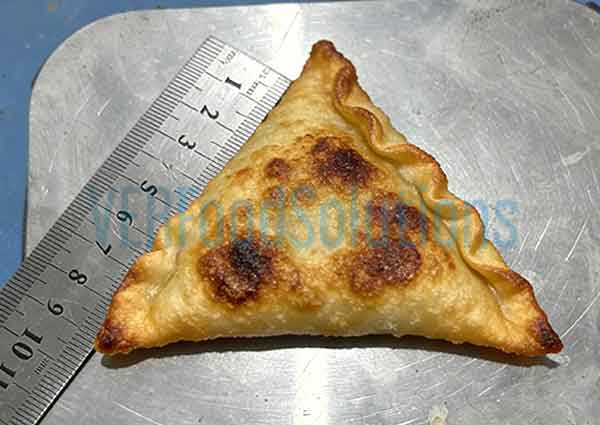
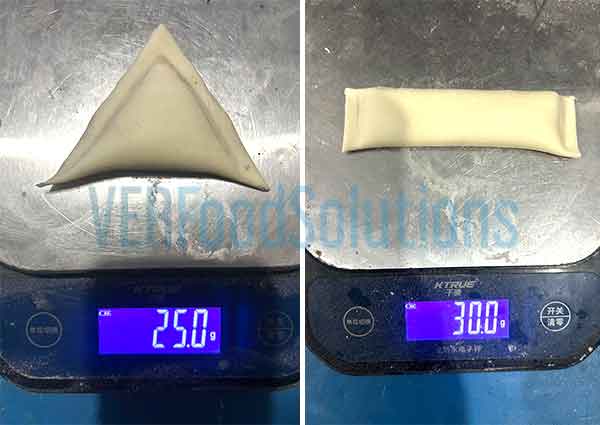
The internal design of the machine is tailored for optimal performance. The spiral dough extrusion structure ensures that the moisture in the dough is retained to the maximum extent, preventing dryness and maintaining the ideal texture of the wrappers. Additionally, the dedicated filling feeding device enables the seamless integration of dough and filling, realizing one-step forming without separation. To cater to the client’s specific product specifications, we customized a frequency converter on the control panel specifically for adjusting the speed of dough and filling discharge. The client produces 10×2.5cm spring rolls weighing 25-30 grams and 8x8x9cm samosas with same weight 25-30grams; adjusting the size and weight of these products only requires turning a knob on the frequency converter. This intuitive and precise adjustment function ensures that the final products consistently meet the required weight standards, safeguarding the client’s product quality and brand consistency. Our samosa machine has a height of only 95cm, with the mesh belt 64cm above the ground, while the input height of all subsequent coating equipment is 78cm. To bridge this height gap and ensure smooth material transfer, we customized a 32cm-high platform for the samosa machine. Taking advantage of the coating equipment’s maximum adjustable height of 83cm, the samosa machine can achieve an output height of 96cm with the platform. This carefully calibrated height difference ensures that the formed samosas and spring rolls can fall smoothly onto the mesh belt of the preduster machine, enabling stable and uninterrupted conveyance throughout the entire coating process.
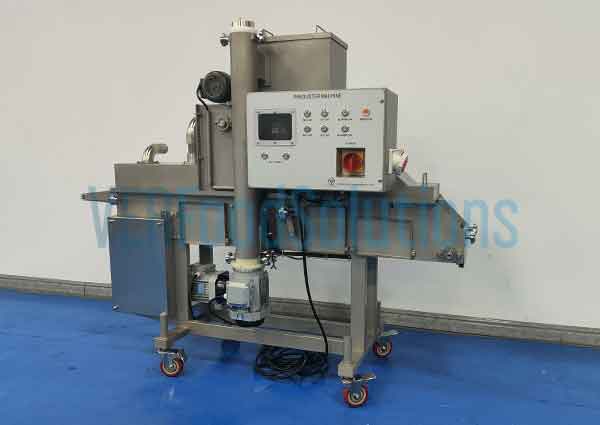
Preduster Machine
VERFOODSOLUTIONS preduster machine was customized to meet the client’s specific requirement: increasing the product weight by at least 5%. While our samosa machine is equipped with a powder-sprinkling function to prevent samosas and spring rolls from sticking together, this function alone cannot achieve the desired weight gain. Our preduster machine, designed exclusively for samosas and spring rolls, addresses this gap perfectly, working in tandem with a matching air flow system to precisely fulfill the powder-coating needs of both products. Featured a 200mm mesh belt for smooth, non-slip continuous feeding, this spring roll samosa machine has an adjustable powder-thickness baffle (controlled via side handle, fixed with nuts) caters to both products—thicker coating for samosa skin toughness, thinner for spring roll crispness—with real-time monitoring via an observation window. Conveyor vibration blocks shake off excess flour for even coverage, preventing samosa frying breakage and preserving spring roll texture. Paired with an independent airflow system, it blows off loose flour (separated and collected by a cyclone separator for cleanliness and waste reduction), avoiding spring roll skin sticking and boosting samosa crispness. The system connects easily via air pipes; both units have 10cm height-adjustable casters for mobility and horizontal operation on uneven ground, ensuring consistent powder coating and safe mass production.
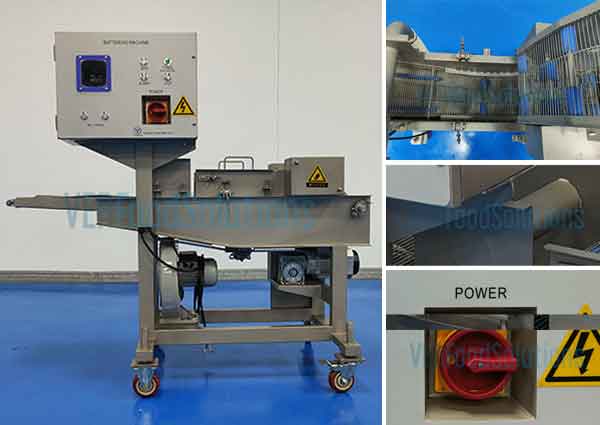
Following the predusting process, the tempura battering machine (specifically designed for samosas and spring rolls) takes over, serving as a crucial link in the coating line. Tailored exclusively for battering samosas and spring rolls, this tempura battering machine boasts practical functions and exceptional adaptability, perfectly matching this USA customer processing needs of special batters containing thickeners, egg liquid, starch, and salt. A standout design of the machine is its height-adjustable double-layer mesh belt. Operators can flexibly adjust the distance between the two mesh belts according to the different thicknesses of samosas and spring rolls. This adjustment ensures uniform pressure on the products, allowing the thick batter (enriched with thickeners and egg liquid) to coat the surface of the ingredients smoothly and evenly. Meanwhile, the gluten strength of the batter coat enhanced by starch and salt lays a solid foundation for the crispy texture of the products after subsequent frying. Regardless of the shape or size of the samosas and spring rolls, this machine achieves consistent and high-quality battering results, effectively improving production efficiency and processing precision. In addition, the equipment is equipped with an adjustable air-blowing function on the discharge belt. Operators can regulate the air volume according to the actual production needs of samosas and spring rolls, accurately blowing off excess thick batter on the product surface. This not only minimizes raw material waste but also optimizes resource management.
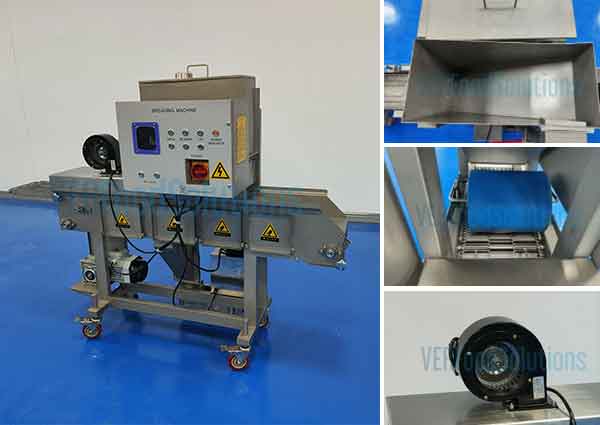
Custom-tailored for samosas and spring rolls post-tempura battering, this breading machine delivers flexible, precise coating control and stable processing performance—operators adjust upper and lower breadcrumb thickness via a handle-linked internal baffle, paired with hinge pump loading capacity and discharge speed tuning to strike the perfect balance for uniform coverage. Its core pressure rollers boast highly flexible height adjustment: fully raised for pressure-free, full immersion coating of soft samosas and spring rolls, ensuring even crumb coverage top to bottom; when the client processes hard products such as chicken nugget patties and meat patties in the future, the pressure roller height can be lowered to press directly on the product surface, compacting the breadcrumb coating to ensure firm adhesion without falling off. Precision rollers coat both product surfaces evenly, with a dedicated feeding hopper dispensing extra crumbs to cover the tops, while a built-in blower system efficiently removes excess crumbs post-coating to prevent oil contamination in the frying machine, extending cooking oil service life and enhancing final product quality; an optional vibration block mechanism on the breadcrumb loader further controls crumb distribution via vibration, reducing overflow risks and boosting the production line’s cleanliness and overall hygiene level.
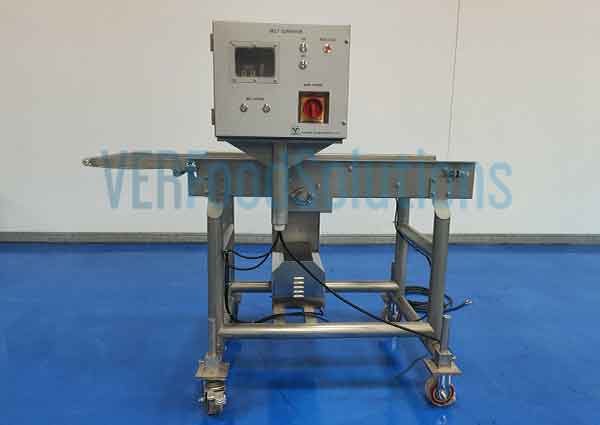
Belt Conveyor Machine Installed between the breading and continuous frying machines, this mesh belt conveyor is a key solution for resolving residual breadcrumb issues for the client—currently producing samosas and spring rolls, with plans to expand to nuggets and patties in 2026. While air-blowing systems remove most excess crumbs from breading (critical for future nugget/patty production), residues persist; this conveyor eliminates them to minimize frying oil contamination, improve oil quality, extend oil service life, and optimize line performance. It offers customizable mesh belt speeds (standard 3–15 m/s; optional 2–10 m/s or 4–18 m/s) to match upstream/downstream rhythms and avoid bottlenecks, plus customizable widths (200mm–1000mm) for stable, non-slip conveyance of current products and scaled output for 2026 expansion. Its robust mesh belt withstands high-temperature, high-frequency continuous operation, while the easy-to-clean structure cuts maintenance downtime and labor costs—laying a solid foundation for the client’s scalable, efficient growth.
Customized for the client’s current samosa/spring roll production and future nugget/patty processing, the continuous frying machine is the final key line link with stable mesh belt conveyance. It features a Teflon-coated anti-stick mesh belt (including input end) to prevent food adhesion, ensure chemical stability, corrosion resistance and anti-aging performance, and extend service life to cut long-term replacement costs. The double mesh belt design with variable frequency speed control sandwiches food for thorough, uniform frying (eliminating floating), with preset adjustable parameters: 165°C for 40 seconds for samosas/spring rolls and 185°C for 30 seconds for nuggets/patties; vector variable frequency regulation lets operators tweak conveyor speed to adjust frying time and output, while the split design enables upper mesh belt height adjustment for different food thicknesses. Prioritizing safety and convenience, it has a switch-controlled lifting system with limit switches (auto-stopping at preset positions; mesh belt and exhaust hood lift/lower together or independently, with a safety bar securing the mesh belt support at maximum height to prevent accidental falls). For oil quality maintenance, a side scraping system removes bottom slag into a trolley, and an advanced 80–100 mesh oil filtration system eliminates tiny impurities to prolong oil life and meet strict US food quality standards, plus a production-scale-matched oil storage tank with a real-time oil level gauge. A user-friendly English control panel streamlines precise parameter adjustment and operator training, boosting overall production efficiency.
This success story of transforming a US restaurant chain’s samosa and spring roll production—from labor-intensive manual work to a 7200-units-per-hour efficient line—proves how tailored coating solutions turn expansion challenges into growth opportunities. Our fully customized equipment not only solved the client’s labor crises and space constraints but also ensured compliance with strict US food safety standards, while laying a flexible foundation for future nugget and patty production. Every component for this preduster battering breading fryer line was designed to align with their unique needs, delivering consistent quality, reduced waste, and streamlined operations.If your food business faces production bottlenecks, seeks to scale, or aims to boost product consistency, let’s collaborate on a personalized production line solution—reach out to our team today to turn your growth goals into reality.