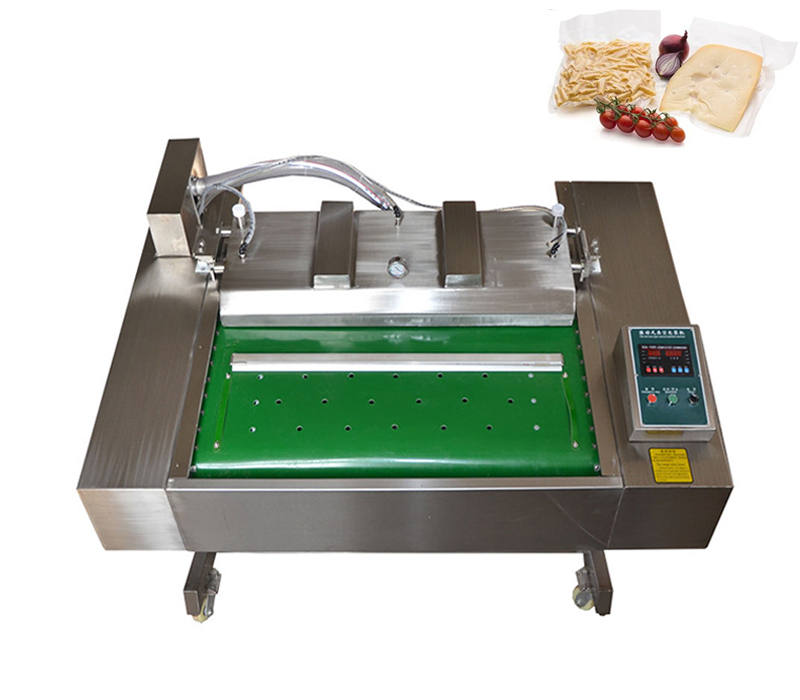
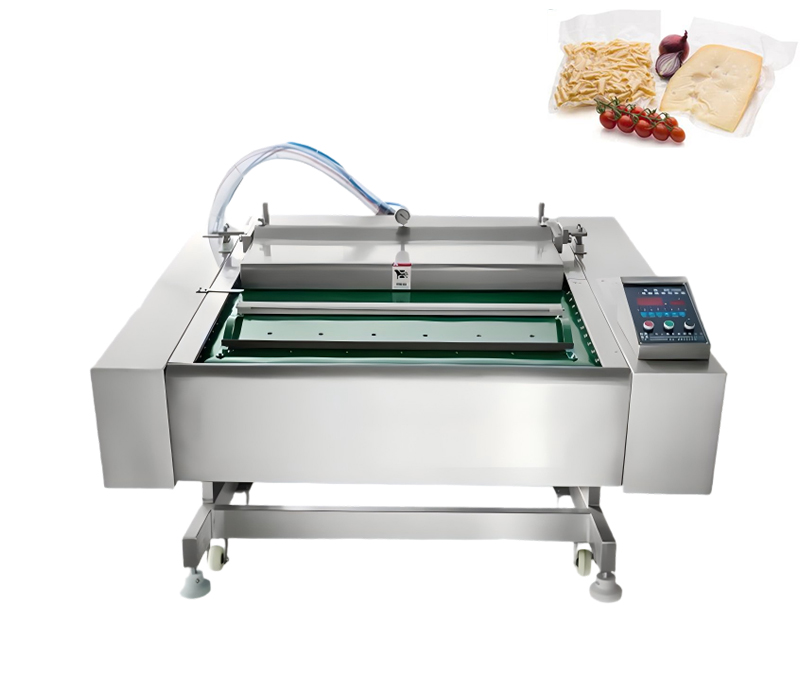
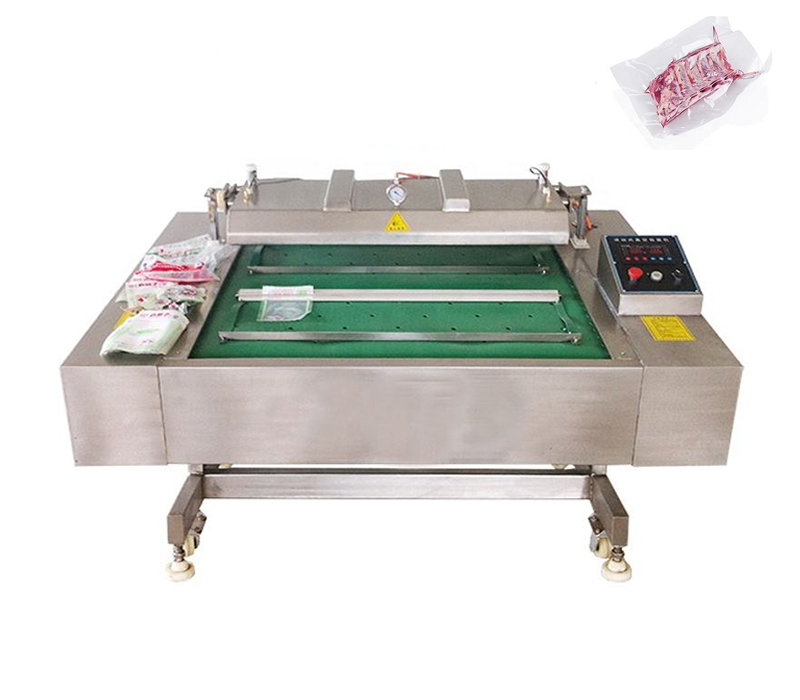
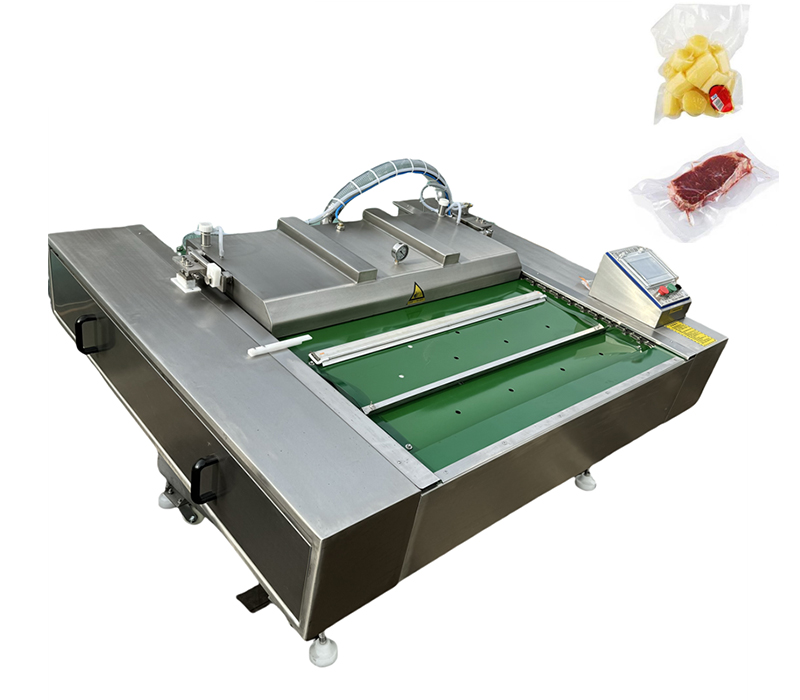
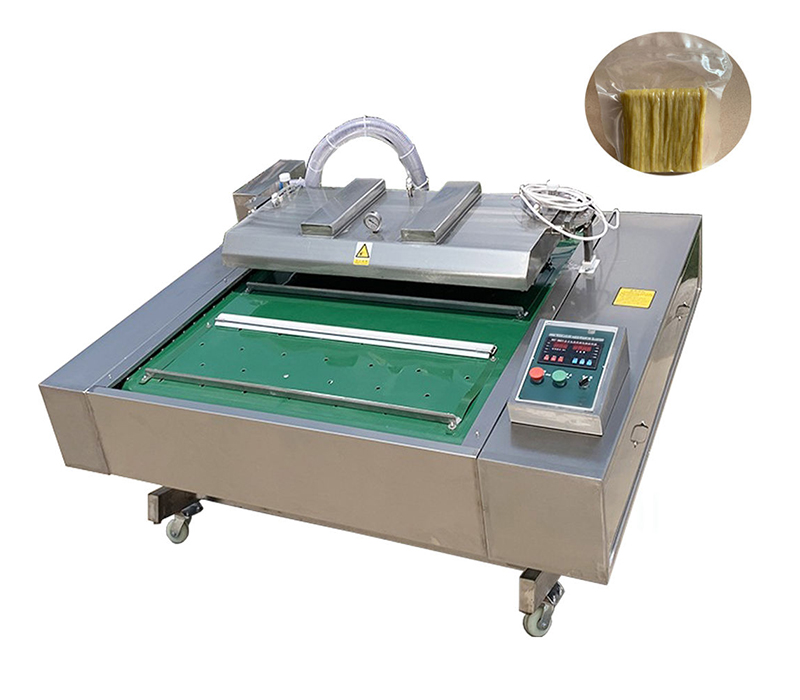
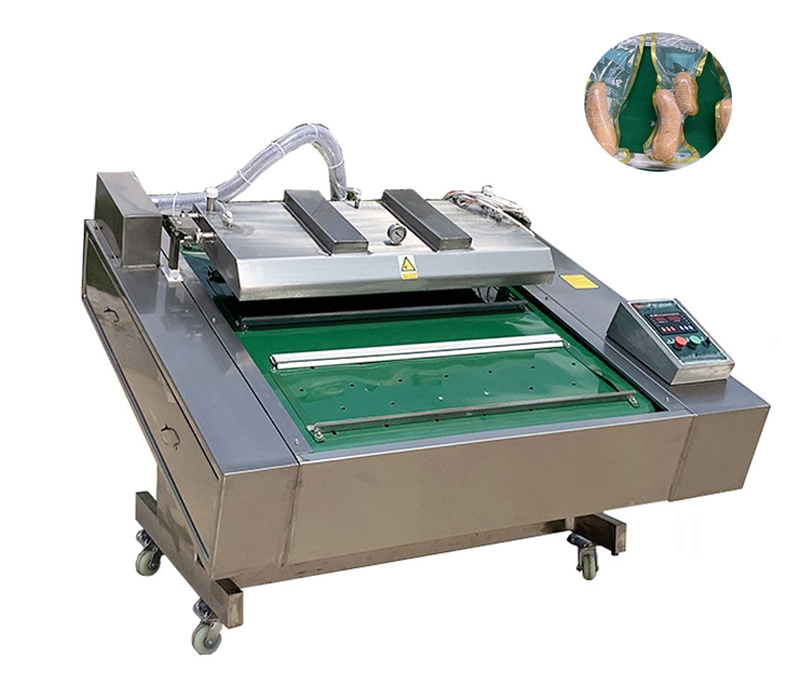
What is the working principle of a belt vacuum packaging machine?A belt vacuum packaging machine operates on a chain drive system with automatic lid opening and continuous product output, utilizing a rolling conveyor belt to vacuum and seal multiple bags simultaneously. It features a large vacuum chamber and long sealing strip, suitable for large items or high-volume packaging, with stable, smooth operation and precise belt positioning that eliminates manual adjustments, saving time and labor. Comprising systems such as transmission, vacuuming, heat sealing, control, and water cooling, the machine uses an external vacuum pump and internal water-cooled sealing device for secure, high-quality seals with rapid cooling. Its automatic lid operation enhances efficiency by removing manual handling, while the spray water pipe facilitates easy cleaning. Capable of sealing dozens of bags at once, it is ideal for large-scale production, providing superior sealing quality, high efficiency, and suitability for various large or high-volume packaging applications. Why should I buy a belt vacuum packaging machine?This belt vacuum packaging machine features an innovative transmission system that automatically opens and closes the vacuum chamber lid, eliminating manual labor, reducing operator workload, and ensuring a consistent opening time to improve efficiency. Its specially designed conveyor belt reduces rolling and stretching, significantly extending its lifespan compared to similar machines, thus offering greater durability. The machine boasts high precision, smooth lifting, and accurate belt positioning, allowing operators to avoid manual adjustments, saving time and effort while meeting continuous packaging demands. It is specifically designed for high-moisture products, with waterproof, moisture-resistant features that make it easy to clean and maintain, and it uses a computer control panel for full, precise control. The equipment’s water-cooled sealing system ensures secure, high-quality seals with rapid cooling, and its robust construction guarantees long service life. Overall, this machine provides reliable, stable performance, enhances work efficiency, and is ideal for high-volume, high-moisture, and large-packaging needs. What are the applications of belt vacuum packaging machine?Belt vacuum packaging machines use plastic or plastic-aluminum foil films to preserve liquids, solids, powders, pastes, foods, grains, fruits, pickles, chemicals, medicinal materials, electronic components, and rare metals, protecting them from oxidation, mold, insects, rot, and moisture to extend shelf life. They are widely used in industries such as meat, tea, food, rice, beans, dates, and pharmaceuticals, offering attractive appearance, compact design, high efficiency, easy operation, and convenient mobility with casters. This machine is widely applicated to below industries: Food Industry – Sealing and preserving meats, sausages, cured meats, salted eggs, and seafood.
– Packaging sticky rice, rice, beans, dates, dried tofu, chicken, and other poultry products.
– Preserving vegetables, pickles, frozen foods, prepared foods, and snacks.
– Maintaining freshness and preventing moisture, mold, rust, and contamination.
– Sterilizing and extending shelf life of perishable food items. Agricultural and Farm Products – Packaging grains, fruits, vegetables, and agricultural produce.
– Preserving high-moisture or liquid products such as pickles and fermented foods.
– Suitable for frozen agricultural items and processed farm products. Pharmaceuticals & Medical Materials – Packaging medicinal materials, powders, pastes, and pharmaceuticals.
– Maintaining sterility and extending shelf life of medical supplies. Electronics & Industrial Components – Sealing electronic components, precision instruments, and rare metals.
– Protecting sensitive items from moisture, oxidation, and contamination. Hardware & Chemical Industries – Packaging hardware parts, powders, chemicals, and powders.
– Ensuring safe, contamination-free storage and transport. Special Applications – Packaging masks and daily necessities.
– Suitable for high-speed, continuous packaging, especially for soft, liquid, or paste-like items.
– Not suitable for irregular or hard items such as frozen goods, which can damage the soft conveyor belt. What are the instructions for using the belt vacuum packaging machine?Preparation Before Operation: – Turn on the cooling water for the vacuum pump and heating rod.
– Check the vacuum pump oil level; since oil mist discharges during pumping, the level will decrease over time. Replenish with #1 vacuum pump oil if low, especially after 16-30 hours of use for liquid foods.
– For liquid foods like pickles, regularly drain old oil and replace it with new oil to maintain pump efficiency. Starting the Machine: – Turn on the main power switch.
– Start the vacuum pump by turning on the pump start switch.
– Turn on the heat seal switch.
– Set the vacuuming time, heat sealing time, and select the heat sealing temperature (high, medium, or low depending on bag thickness).
-Press the start switch to run the machine automatically, which will cycle continuously. Stopping Operation: – To stop, turn off the start switch; the machine will finish its cycle and return to the starting position.
– For an immediate stop, press the emergency stop switch which halts the machine instantly and raises the working chamber. After Operation: – Turn off the start switch and the heat sealing switch.
– Turn off the pump start switch to stop the vacuum pump, allowing air to enter the pipeline.
– Turn off the water supply to the vacuum pump and heating rod.
– Clean the conveyor belt, sealing platform, and gaskets around the chamber. Wipe the machine with a cloth to maintain hygiene.
– Turn off the main power switch. Maintenance Tips: – Ensure cooling water is connected during continuous operation exceeding 30 minutes for heat sealing quality and safety.
– When shutting down, turn off the vacuum pump before turning off the main power, especially with the chamber open.
– Adjust heating time so the vacuum level exceeds 0.0533 MPa before sealing to guarantee quality and prevent damage.
– Keep the sealing surfaces clean and free of foreign matter to ensure good sealing and prolong component life.
– Never perform maintenance with the machine powered on; avoid disassembly unless qualified.
– Do not place the machine upside down or subject it to impacts or collisions, especially affecting electrical parts.
– Replenish gearbox oil with No. 20 machine oil and lubricate rotating parts regularly to ensure smooth operation. What are the maintenance and repair tips for the rolling vacuum packaging machine?Daily cleaning: – After each use, clean the vacuum chamber and heat-sealing strip to remove residue.
– Wipe the outer surface with a damp cloth.
– Do not use corrosive cleaning agents.
– Always turn off the machine before cleaning. Vacuum pump maintenance: – Check the oil level regularly; keep it at about 2/3 of the oil window.
– Use dedicated vacuum pump oil.
– Change the oil every 1500-2000 hours of operation.
– Change the oil filter and air filter at the same time.
– Before changing oil, run the pump for 15-30 minutes to warm the oil, then turn off. Lubrication and inspection: – Lubricate moving parts like drive shafts, gears, connecting rods, and sliders with 20# machine oil or grease.
– Inspect heating strips and sealing rings regularly for wear or damage.
– Replace worn or aging parts promptly. Working environment: – Place the machine in a well-ventilated, dry area.
– Keep away from moisture and high temperatures. Operator training: – Ensure operators are trained professionally.
– Follow proper operating procedures to prevent damage. Maintenance records: – Keep a detailed log of all cleaning, inspections, oil changes, and parts replacements.
– This helps track issues and schedule future maintenance. Long-term storage: – If not used for a long period, power on the machine periodically to keep components flexible. How to replace the heating strip on the belt vacuum packaging machine?-Remove the bolt in the middle of the heating rod.
-Take out the heating rod from the machine.
-Disconnect the wires at both ends of the heating rod.
-Remove the water pipes at both ends.
-Loosen the screws on the pressure plate at both ends of the heating rod.
-Remove the old heating strip and inspect the enamel tape for damage.
-Clean the heating rod and strip with alcohol or gasoline; ensure they are dry and free of impurities.
-Apply a new enamel tape smoothly and wrinkle-free on the heating rod.
-Fix the nickel-chromium alloy strip to one end of the heating rod.
-Tighten the other end with a wrench and secure the strip with the pressure plate.
-Trim any excess tape at both ends to prevent short circuits.
-Apply an outer layer of enamel tape.
-Reassemble all parts in the reverse order of disassembly. What factors affect the lifespan for heating strips of belt vacuum packaging machine?The durability and lifespan of heating strips are influenced by several factors related to material quality, design, operating conditions, and maintenance practices. Proper understanding and management of these factors can help extend the service life of the heating elements, ensuring consistent sealing performance and reducing replacement costs. Heating strip material: commonly nickel-chromium, iron-chromium, or stainless steel. Nickel-chromium is the most durable but also the most expensive (3-5 times costlier). Stainless steel is less durable. It is recommended to choose nickel-chromium alloy heating strips for longer lifespan. Oxidation of copper posts: domestic vacuum machines often use copper screw posts for the heating tape. When these posts oxidize (turn black), the heating tape is more prone to burnout. Imported machines with collet-type designs handle oxidation better. Transformer power: insufficient transformer capacity (due to cost-cutting or poor quality) can lead to inadequate power supply, shortening the heating strip’s lifespan. Vacuuming time: too short vacuuming results in residual air in the chamber, causing premature oxidation and wear of the heating strip. Longer, proper vacuuming extends the lifespan. Heating program design: a proper heating cycle starts heating only when the belt presses against the sealing line. If it heats immediately after vacuuming (to save time), it may cause dry burning and reduce the heater’s lifespan. In conclusion, choosing high-quality materials, ensuring proper operating conditions, and following correct maintenance practices are key to maximizing the lifespan of heating strips. Regular inspection and optimal usage can significantly improve sealing consistency and reduce replacement costs over time. | |

Leave a Reply